Charles Miller (2002, 2004; Princeton High, Princeton, MN): Charles spearheaded a continuing exploration into the mysterious sources discovered by NASA's Compton Gamma Ray Observatory. Charles used UW's 24-inch telescope at Red Buttes Observatory and our 2.3 m telescope at the Wyoming Infrared Observatory to search for and monitor optical counterparts to gamma ray sources.
Chad Sharpe (2005; Kelly Walsh High, Casper, WY): Chad took wide-field CCD images of nearby star-forming galaxies and developed a curriculum that involved producing (stellar) continuum-free data of H-alpha line emission from HII regions.
Michelle Miller (2006: Science Museum, Casper, WY): Michelle will be working with me on our survey of the evolution in the cosmis star formation rate, using our 2.3m telescope on Mt. Jelm.
Astro Camp intentionally focusses on middle/junior high school students, an oft-overlooked age level which research shows is pivotal in determining interest in science, especially for girls. Consultation with other campus outreach programs revealed that, while a half dozen high school outreach programs exist at UW, there are few if any summer residential programs working with junior high students! In addition to bringing in these students, we also recruit WY science teachers and UW graduate and undergraduate science students to help run Astro Camp. Typically, the science teachers stay in Laramie for an additional few weeks to polish curriculum they developed for Astro Camp and to get an exciting exposure to professional astronomy by doing research with UW faculty.
Astro Camp comes in two flavors. One version usually involves about 20 students from the Boys & Girls Clubs of Wyoming and the Youth Alternatives Program spending three days in Laramie. The other version of Astro Camp is open to all middle/ junior high school students in WY. Approximately 20 students are chosen for their scholastic record and for their interest in science. Campers are kept extremely busy during their stay: campers work with UW astronomers; take and analyze astronomical data using UW telescopes; explore several hands-on physics experiments; build, launch, and analyze the flight paths of model rockets; simulate astronaut training by constructing "satellites" in Half Acre Pool using SCUBA equipment; receive an introduction to science fiction writing from resident author Professor Brotherton; operate from a central "command center" remote cameras mounted on "UW Rovers" to explore campus; and participate in other activities that keep them generally immersed in the world of space science. Modeled after successful programs in other states, Wyoming Astro Camp fosters community between astronomers, teachers, schools, and municipalities throughout Wyoming for the purpose of educating and equipping its citizens.


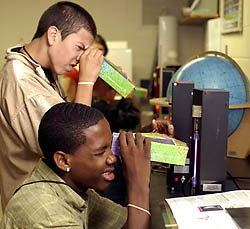
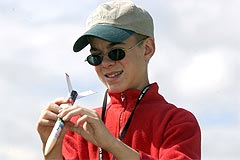
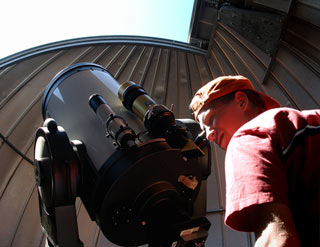
ASTRO CAMP -- Left (2003): Kelly Walsh High School students Ian Moore, top and Antoine Miller, along with other students from the Casper Boys and Girls Clubs, constructed spectroscopes during a recent science camp sponsored by the UW Department of Physics and Astronomy. Participants used telescopes, launched rockets and had an opportunity to learn about career and educational opportunities in science. Center (2004): Ian Hitchcock from Dubois checks out his rocket before launching it during the University of Wyoming's Astronomy Camp. Youths built and launched their own rockets, constructed a model solar system, conducted scientific experiments and learned to use telescopes during the three-day camp. The UW Department of Physics and Astronomy organizes the annual event. Right (2006): Young astronomer David Russell of Wheatland examines solar flares through a filtered telescope during the recent astronomy camp at the University of Wyoming. Youths learned how to use telescopes, built and launched their own rockets, constructed satellites under water, and conducted scientific experiments during the five-day science camp(UW Photos and captions)