
|
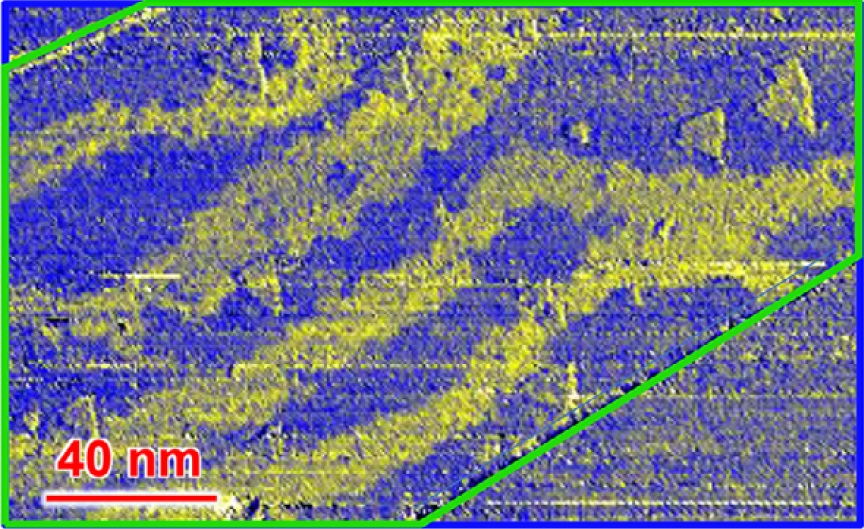
Te Vacancies Induced Magnetic Domains and Domain Wall Stabilization on Fe3GeTe2 SurfacesFe3GeTe2 (FGT) is a van der Waals (vdW) ferromagnetic (FM) metal. When the thickness is around tens of nm, it exhibits thickness, temperature, and magnetic field dependent magnetic phases, including skyrmions, magnetic stripes, and labyrinth magnetic domains. These magnetic phases can be further influenced by Fe defects, interfacial Dzyaloshinskii–Moriya interaction (DMI), and strain. Here, the influences of Te vacancies on the magnetic domains on the surfaces of FGT are reported. The Te vacancies are introduced during the exfoliation process and are determined from the atomic resolution scanning tunneling microscopy (STM) images. Te vacancies are found to be responsible for inducing magnetic domains with opposite magnetic moments on the otherwise ferromagnetic surface. Magnetic domain expands upon increasing the temperature, and the Te vacancies serve to stabilize magnetic domain boundaries during the expansion of the magnetic domain sizes. Also, a theoretical model describing the role of Te vacancies to reduce the domain wall energy and hence acting as pinning sites to form the labyrinth like magnetic domain has been presented. The results presented here point out that the Te vacancies may play a significant role in altering magnetic phases. Read more: D. Baral et al., Adv. Funct. Mater. https://doi.org/10.1002/adfm.77224(2026). |
|
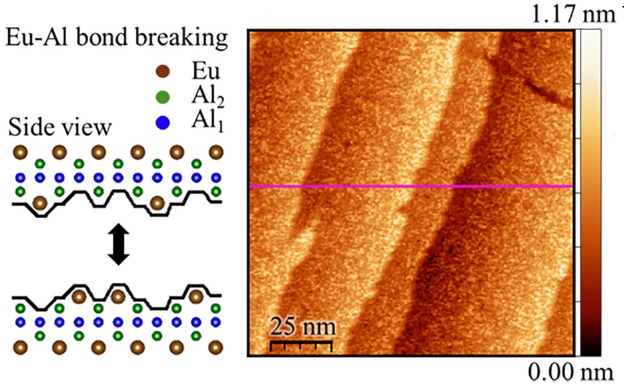
Surface morphology and electronic properties of cleaved centrosymmetric EuAl4(001)EuAl4, a centrosymmetric magnetic rare-earth transition-metal intermetallic compound, exhibits intriguing properties, such as topological states and topological magnetic textures (skyrmions). The surface termination and morphology of the cleaved surface are still not fully explored, leading to a challenging understanding of surface sensitive measurements. Here, the cleaved EuAl4(001) surface is studied via scanning tunneling microscopy and spectroscopy (STM/S) and low-energy electron diffraction (LEED). Topographic images reveal a step-and-terrace morphology with terrace sizes ranging from a few nanometers to a few microns. The step heights are determined to be predominately one-half unit cell (~5.58 Å). The terraces exhibit a surface morphology with a roughness of ~1.50 Å. This is believed to be caused by equivalent Eu-Al and Al-Eu cleavage planes due to the centrosymmetric crystal structure together with the energetic cleaving process that disrupts the surface topography. Spectroscopic measurements on the surface yielded three distinct types of spectra, primarily contributed by Al adatoms (type 1), Eu adatoms (type 2), and a combination of both (type 3), as elucidated with the help of density functional theory calculations. Our results show that the cleaved EuAl4 (BaAl4 family) surface exhibits a higher level of disorder than ThCr2Si2-type compounds. Read more: Grant et al., Phys. Rev. B 113, 075418 (2026). |
|
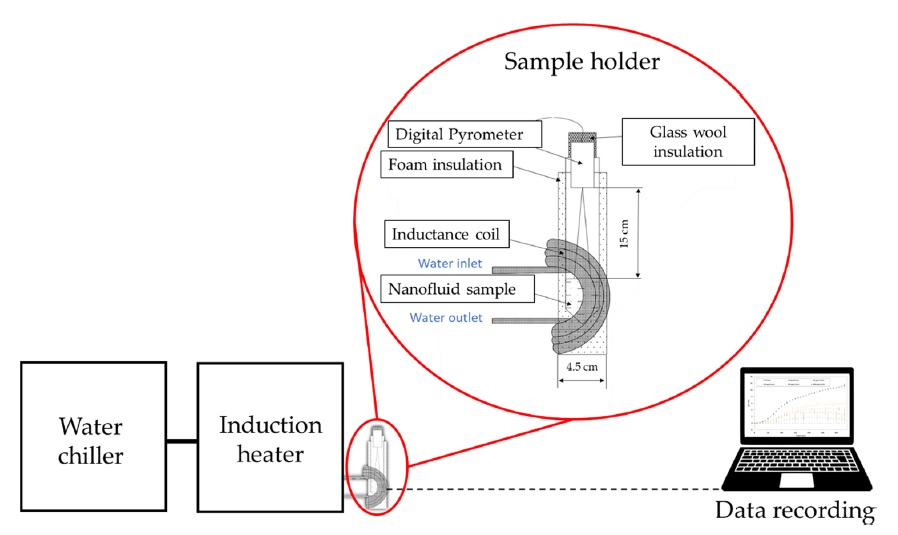
Magnetic nanoparticle detection methods in the context of complex fluidsFoams improve mobility control in injection operations within geological settings. Nanoparticles, such as iron-oxide, have been shown to enhance the stability of foams when combined with surfactants. In this research, we leverage the magnetic properties of these nanoparticles to detect their presence as a surrogate for monitoring the geologic extent of injected fluids in the subsurface. The feasibility of using these nanoparticles for monitoring purposes stems from their detectability at low concentrations in subsurface environments. We developed two distinct methods to detect the presence of magnetite nanoparticles in complex fluids. To simulate complex subsurface fluids in a laboratory setting, we included various ions and surfactants and investigated their effects on the detection of nanoparticles. To this end, we designed an experimental setup and tested two magnetic detection methods: Induction Heating (IH) and Oscillator Frequency Shift (OFS). The IH method involves applying a high-frequency alternating magnetic field to a solution containing small amounts of magnetic nanoparticles and measuring the temperature response. We built an experimental setup to generate this magnetic field for different samples, with temperature changes recorded by an infrared camera. The results indicate that nanoparticle concentrations linearly affect the solution's temperature rise. However, the presence of ions and surfactants also influences the temperature response. The OFS method measures shifts in the resonance frequency of a circuit caused by changes in magnetic permeability inside a coil. This coil is part of a transistor oscillator circuit that produces a sinusoidal voltage waveform, with the oscillation frequency depending on the coil’s inductance. The presence of nanoparticles causes a shift in resonance frequency, which were precisely measured for various samples. The drop in resonance frequency is a linear function of nanoparticle concentration, and both methods detect concentrations as low as 150 mg/L of Fe3O4 nanoparticles. Read more: Orujov et al., Int. J. Coal Sci. Technol. 11, 86 (2024). |
|
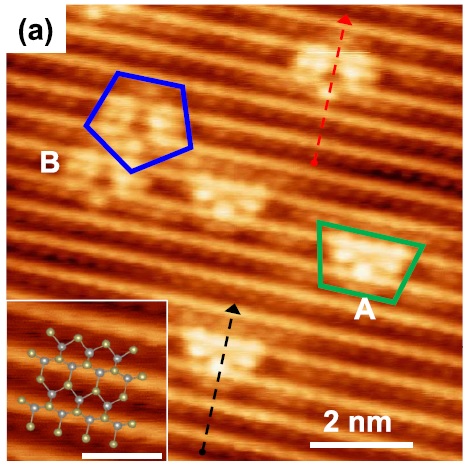
Possible coexistence of magnetism and paramagnetic singularity in lightly Fe-doped WTe2Topological semimetals possess nodal or nodal-line phases where conduction and valence bands touch at points or lines in momentum space, respectively. Such band touching is symmetry protected and gives rise to exotic and interesting electronic properties. Coupling topological order with magnetism provides a platform for exploring time-reversal (TR) symmetry breaking topological physics, such as axion electrodynamics, inverse spin-galvanic effect, and the quantized anomalous Hall effect. The Weyl semimetal (WSM) requires breaking either TR symmetry or lattice inversion symmetry (I). By doping inversion-symmetry-broken WSM with magnetic dopants, one can expect to create a WSM with both symmetries breaking simultaneously. Here, structural, electrical, and magnetic properties of FexW1-xTe2 (x = 0 and 0.011) are reported. It is revealed that, with a small Fe doping concentration (x = 0.011), a ferromagnetism is induced at low temperature (<10 K). Scanning tunneling microscopy and spectroscopy measurements in Fe0.011W0.989Te2 further reveal only substitution and no intercalated dopants being observed. The probabilities of the Fe substitutions at the two nonequivalent W sites are quantified with equal probability. The dI/dV point spectra indicates that the Fe substitution in WTe2 manifests itself as electron doping regardless of doping sites. The results clearly reveal the possible coexistence of magnetism and Weyl points in the lightly Fe doped WTe2 at low temperature. This provides an ideal system for further study on the interplay between the topological Weyl points and the TR symmetry breaking. Read more: D. Baral et al., Phys. Rev. B 109, 245419 (2024). |
|
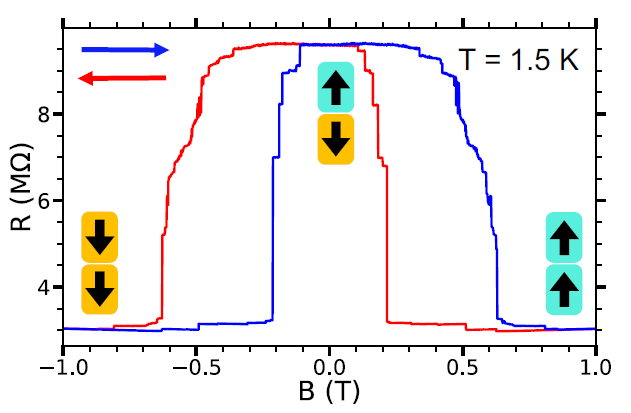
Tunneling current-controlled spin states in few-layer van der Waals magnetsEffective control of magnetic phases in two-dimensional magnets would constitute crucial progress in spintronics, holding great potential for future computing technologies. Here, we report a new approach of leveraging tunneling current as a tool for controlling spin states in CrI3. We reveal that a tunneling current can deterministically switch between spin-parallel and spin-antiparallel states in few-layer CrI3, depending on the polarity and amplitude of the current. We propose a mechanism involving nonequilibrium spin accumulation in the graphene electrodes in contact with the CrI3 layers. We further demonstrate tunneling current-tunable stochastic switching between multiple spin states of the CrI3 tunnel devices, which goes beyond conventional bi-stable stochastic magnetic tunnel junctions and has not been documented in two-dimensional magnets. Our findings not only address the existing knowledge gap concerning the influence of tunneling currents in controlling the magnetism in two-dimensional magnets, but also unlock possibilities for energy-efficient probabilistic and neuromorphic computing. Read more: Z. Fu et al., Nature Commun. 15, 3630 (2024). |
|
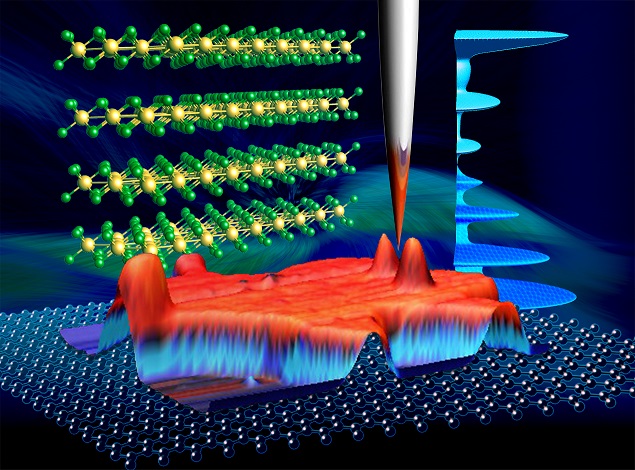
Small Energy Gap Revealed in CrBr3CrBr3 is a layered van der Waals (vdW) material with magnetic ordering down to the 2D limit. For decades, based on optical measurements, it is believed that the energy gap of CrBr3 is in the range of 1.68-2.1 eV. However, controversial results have indicated that the band gap of CrBr3 is possibly smaller than that. An unambiguous determination of the energy gap is critical to the correct interpretations of the experimental results of CrBr3. Here, we present the scanning tunneling microscopy and spectroscopy (STM/S) results of CrBr3 thin and thick flakes exfoliated onto highly ordered pyrolytic graphite (HOPG) surfaces and density functional theory (DFT) calculations to reveal the small energy gap (peak-to-peak energy gap to be 0.57 eV ± 0.04 eV; or the onset signal energy gap to be 0.29 ± 0.05 eV from dI/dV spectra). Atomic resolution topography images show the defect-free crystal structure and the dI/dV spectra exhibit multiple peak features measured at 77 K. The conduction band - valence band peak pairs in the multi-peak dI/dV spectrum agree very well with all reported optical transitions. STM topography images of mono- and bi-layer CrBr3 flakes exhibit edge degradation due to short air exposure (~15 min) during sample transfer. The unambiguously determined small energy gap settles the controversy and is the key in better understanding CrBr3 and similar materials. Read more: D. Baral et al., PhysChemChemPhys 23, 3225-3232 (2021). |
|
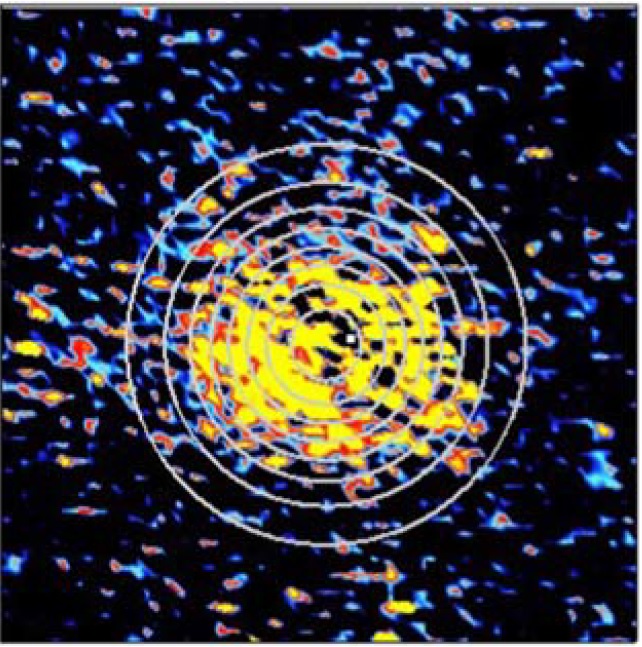
Large Spatial Extension of the Oxygen Vacancy induced Electronic Wavefunction on EuO1-x SurfacesEuO is a Heisenberg ferromagnet with a Curie temperature of 69 K. By doping it with oxygen vacancies or other metallic elements, intriguing properties emerged. For examples, metal-to-insulator transition, enhancement of the Curie temperature, and exhibiting topological Hall effect. Several theoretical models have been proposed in the past decades to explain these interesting phenomena and it is still controversial which model is favorable. Among them, bound magnetic polaron (BMP), RKKY, and ferromagnetic Kondo-lattice models are among the most plausible ones. To shed light on determining the model, we performed high resolution STM measurements on EuO1-x surfaces and revealed large spatial wave function extension (~1.8 nm). This results are in favor of the BMP model.Read more: Wang et al. Mater. Res. Express 6, 116408 (2019). |
|
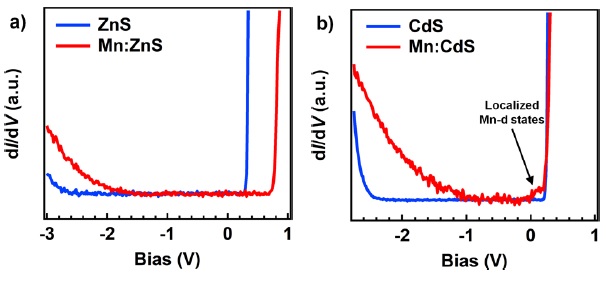
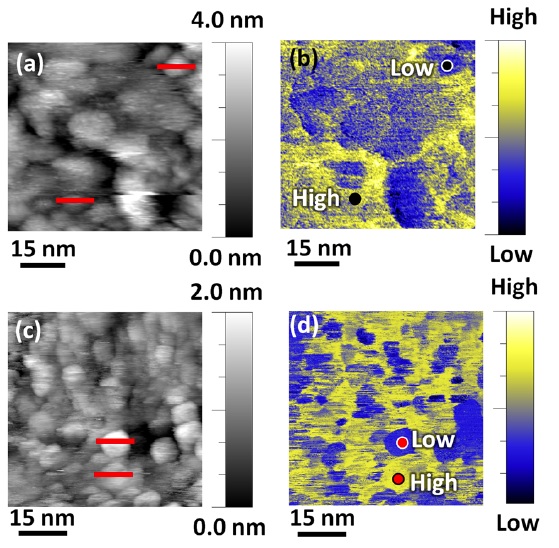
Influence of the Mn Doping on the Electronic and Magnetic Properties of CdS and ZnS Quantum DotsDoping semiconductors with transition metal elements may change the physical properties of the host materials. In a sense, the dopant can provide electron or hole doping. Also, if the transition metal has magnetic moment, it can also affect the magnetic properties. Here, we study the Mn doping in the CdS and ZnS semiconductors and revealed that the Mn doping has complex influence on the physical properties in CdS and ZnS by different mechanism. Ridig band shifting was observed in ZnS while it is not the case for CdS. Read more: A. J. Yost et al., J. Phys. Chem. C 123, 24890-24898 (2019). |
|
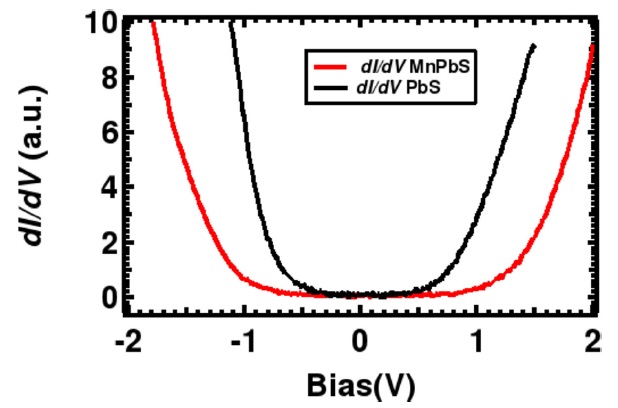
Mn dopant locations affect the sp-d hybridization strengthDilute magnetic semiconductors (DMS) have been studied for decade owing to its attractive properties of magnetism in semiconductors. Typically, DMS is achieved by doping semiconductors with transition elements, such as Mn. The sp-d hybridization between the sp band edge states of the semiconductors and the electrons in the d orbitals in the transition elements strongly influence the DMS properties. The DMS is well studied in bulk or thin film forms while the quantum dot (QD) form of DMS is considered very difficult. This is mainly due to the so-called "self-purification" process, in which the dopants tend to aggregate at the surfaces of the QDs. Despite the difficulty, many researchers have reported successful synthesis, the change of the physical properties, and the applications of the DMS QDs. However, so far, though mentioned, it is rarely studied that the location effects of the transition element dopants on the physical proeprties of host semiconducting QDs. In this study, we utilized STM/S to study PbS and Mn:PbS QDs synthesized by pulsed laser deposition methods. Combining results from various measurements and density functional theory calculation, we revealed that the Mn dopant locations may affect the sp-d hybridization strength in the PbS QDs and manifest itself as different level of bandgap widening. Read more: A. Yost et al., Appl. Phys. Lett. 111, 233101 (2017). |
|
Mn Dopint Effects in PbS Quantum Dots for Applications in Quantum Dot Sensitized Solar CellsSolar cell applications have been thought as one of the major renewable energy resources in the future. Many types of solar cell materials have been studied to achieve the goals of large scale utilization. Among them, quantum dot sensitized solar cells (QDSSCs) are one of the most applicable cells. To further increase the efficiency of the QDSSCs, methods to extend the lifetime of the short lived excitons created in the QDs are the key. Here, we studied the magnetic element, Mn, doping effects into the semiconducting PbS QDs on the QDSSC applications. In this work, the Mn doped PbS QDs were deposited onto Zn2SnO4 (ZTO) nanowires (NWs), which are served as semiconducting electrodes to cllect the electrons injected from the QDs. It is found that the Mn doping widened the energy band gaps in PbS QDs, and most importantly, the Mn element on the surfaces of PbS QDs in contact with ZTO NWs lowered the energy barrier for electron injection from PbS QDs to the ZTO NWs. Due to the presence of the interfacial Mn atoms, the incident photon-to-current efficiency (IPCE) increased up to 700 % (with an average 300 % enhancement). This discovered enhancement mechanism may be a new way of engineering QDSSCs for further improvements. Read more: G. Rimal et al., Appl. Phys. Lett. 109, 103901 (2016). |
|
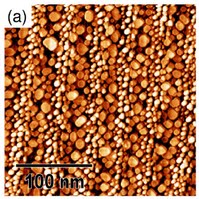
Controlling the Fe Films Deposited on Striped-Termination on Fractured SrTiO3 SurfacesThough the formation mechanism of the striped-termination on the fractured SrTiO3 (STO) surfaces is still unclear, it could be used for controlling the morphology of the deposited Fe films on the fractured STO surfaces. By utilizing STM, the evolution of the Fe film morphology was revealed under heat treatment in ultrahigh vacuum (UHV) environment. The comparison to the high temperature evolution of the bare fractured STO further concludes that the interfacial energy of Fe/SrO interface is higher than that of Fe/TiO2 interface. This result demonstrates an efficient way of controlling/fabricating nano-particles on a large area, nano-scale ordered, and self-assembled striped-termination surface. Read more: TeYu Chien et al., Appl. Phys. Lett. 100, 031601 (2012). |
|
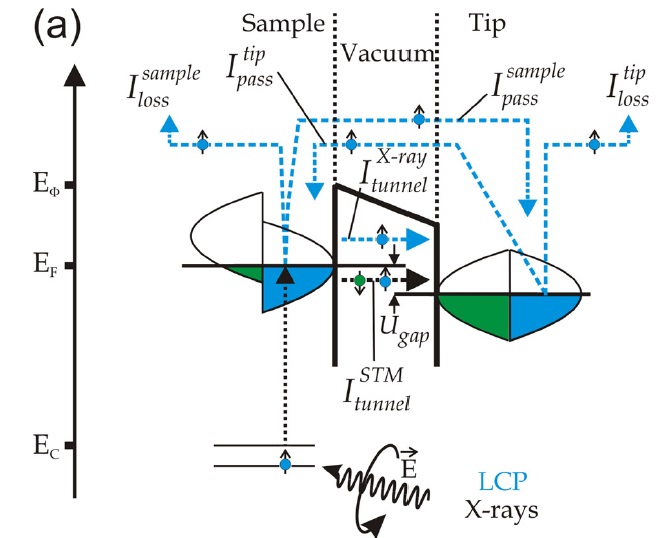
Spin-Dependent Synchrotron X-ray Excitations Probed with Scanning Tunneling MicroscopyX-ray magnetic linear dichroism (XMLD) and x-ray magnetic circular dichroism (XMCD) are two modes of the synchrotron x-ray spectroscopy that reveal the orientation of charge distribution and the magnetic moment near the targeted ions, respectively. The spatial resolution of the traditional XMLD and XMCD is in micro-meter scale, which is limited by the spot size of the synchrotron x-rays. Recent developments in nano-probing techniques are targeting to shrink the spot size. An alternative approach is to change the probing mechanism. By using SXSTM, the photo-ejected electrons by illuminating synchrotron x-rays are collected by a special prepared smart tip (see below). Here, we demonstrate that by switching the left circularly polarized (LCP) and right circularly polarized (RCP) synchrotron x-rays in the SXSTM system, the XMCD signal could be probed by the smart tip. This demonstration pushes the spatial resolution of XMCD by alternating the probing method. Read more: V. Rose et al., J. Appl. Phys. 111, 07E304 (2012). |
|
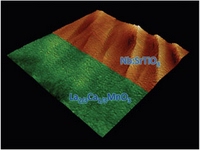
Directly Probing Complex Oxide Interfaces With XSTMBy utilizing the fracturing technique for complex oxides, the STM now is able to probe the interface of PLD grown epitaxial films with substrates. The first demonstration on harness XSTM on complex oxide interfaces is done in our lab with La2/3Ca1/3MnO3 (LCMO) film grown on Nb-doped SrTiO3 (Nb:STO) substrate. The observed abrupt morphology changes across the interface is mainly due to the different fracturing toughness between film material and substrate material. Further more, by measuring tunneling spectrum across the interfaces with scanning tunneling microscopy (STS), the valence and conduction band of the two materials could be extracted. Thus the band diagram (spatial evolution of the energy bands across the interface) could be directly probed. This opens a new route to study the energy band bending at complex oxide interfaces. Read more: TeYu Chien et al., Phys. Rev. B 82, 041101(R) (2010). |