
|
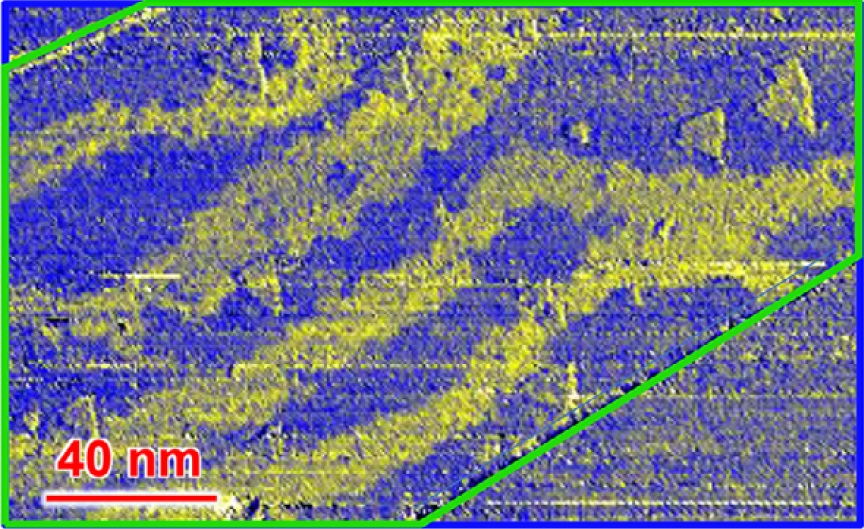
Te Vacancies Induced Magnetic Domains and Domain Wall Stabilization on Fe3GeTe2 SurfacesFe3GeTe2 (FGT) is a van der Waals (vdW) ferromagnetic (FM) metal. When the thickness is around tens of nm, it exhibits thickness, temperature, and magnetic field dependent magnetic phases, including skyrmions, magnetic stripes, and labyrinth magnetic domains. These magnetic phases can be further influenced by Fe defects, interfacial Dzyaloshinskii–Moriya interaction (DMI), and strain. Here, the influences of Te vacancies on the magnetic domains on the surfaces of FGT are reported. The Te vacancies are introduced during the exfoliation process and are determined from the atomic resolution scanning tunneling microscopy (STM) images. Te vacancies are found to be responsible for inducing magnetic domains with opposite magnetic moments on the otherwise ferromagnetic surface. Magnetic domain expands upon increasing the temperature, and the Te vacancies serve to stabilize magnetic domain boundaries during the expansion of the magnetic domain sizes. Also, a theoretical model describing the role of Te vacancies to reduce the domain wall energy and hence acting as pinning sites to form the labyrinth like magnetic domain has been presented. The results presented here point out that the Te vacancies may play a significant role in altering magnetic phases. Read more: D. Baral et al., Adv. Funct. Mater. https://doi.org/10.1002/adfm.77224(2026). |
|
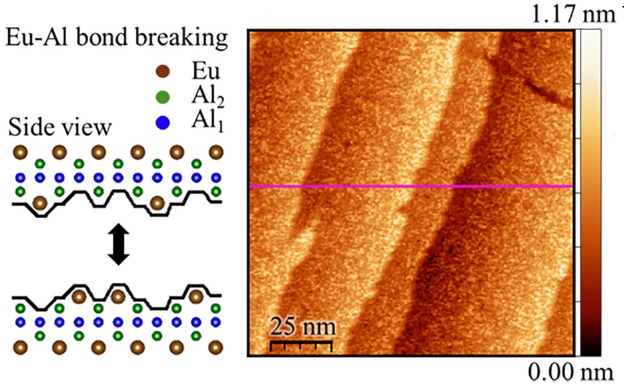
Surface morphology and electronic properties of cleaved centrosymmetric EuAl4(001)EuAl4, a centrosymmetric magnetic rare-earth transition-metal intermetallic compound, exhibits intriguing properties, such as topological states and topological magnetic textures (skyrmions). The surface termination and morphology of the cleaved surface are still not fully explored, leading to a challenging understanding of surface sensitive measurements. Here, the cleaved EuAl4(001) surface is studied via scanning tunneling microscopy and spectroscopy (STM/S) and low-energy electron diffraction (LEED). Topographic images reveal a step-and-terrace morphology with terrace sizes ranging from a few nanometers to a few microns. The step heights are determined to be predominately one-half unit cell (~5.58 Å). The terraces exhibit a surface morphology with a roughness of ~1.50 Å. This is believed to be caused by equivalent Eu-Al and Al-Eu cleavage planes due to the centrosymmetric crystal structure together with the energetic cleaving process that disrupts the surface topography. Spectroscopic measurements on the surface yielded three distinct types of spectra, primarily contributed by Al adatoms (type 1), Eu adatoms (type 2), and a combination of both (type 3), as elucidated with the help of density functional theory calculations. Our results show that the cleaved EuAl4 (BaAl4 family) surface exhibits a higher level of disorder than ThCr2Si2-type compounds. Read more: Grant et al., Phys. Rev. B 113, 075418 (2026). |
|
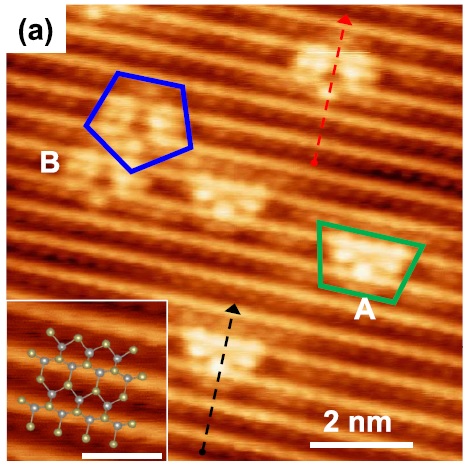
Possible coexistence of magnetism and paramagnetic singularity in lightly Fe-doped WTe2Topological semimetals possess nodal or nodal-line phases where conduction and valence bands touch at points or lines in momentum space, respectively. Such band touching is symmetry protected and gives rise to exotic and interesting electronic properties. Coupling topological order with magnetism provides a platform for exploring time-reversal (TR) symmetry breaking topological physics, such as axion electrodynamics, inverse spin-galvanic effect, and the quantized anomalous Hall effect. The Weyl semimetal (WSM) requires breaking either TR symmetry or lattice inversion symmetry (I). By doping inversion-symmetry-broken WSM with magnetic dopants, one can expect to create a WSM with both symmetries breaking simultaneously. Here, structural, electrical, and magnetic properties of FexW1-xTe2 (x = 0 and 0.011) are reported. It is revealed that, with a small Fe doping concentration (x = 0.011), a ferromagnetism is induced at low temperature (<10 K). Scanning tunneling microscopy and spectroscopy measurements in Fe0.011W0.989Te2 further reveal only substitution and no intercalated dopants being observed. The probabilities of the Fe substitutions at the two nonequivalent W sites are quantified with equal probability. The dI/dV point spectra indicates that the Fe substitution in WTe2 manifests itself as electron doping regardless of doping sites. The results clearly reveal the possible coexistence of magnetism and Weyl points in the lightly Fe doped WTe2 at low temperature. This provides an ideal system for further study on the interplay between the topological Weyl points and the TR symmetry breaking. Read more: D. Baral et al., Phys. Rev. B 109, 245419 (2024). |
|
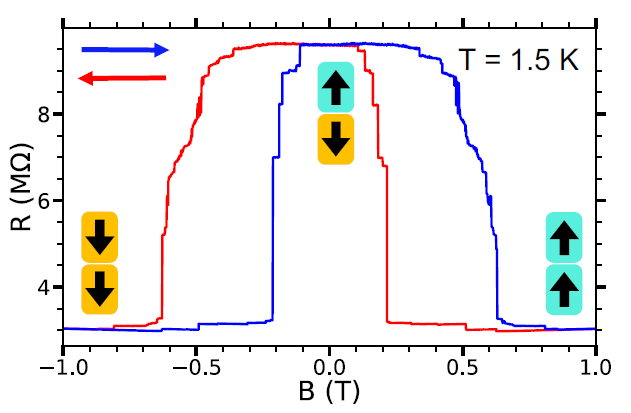
Tunneling current-controlled spin states in few-layer van der Waals magnetsEffective control of magnetic phases in two-dimensional magnets would constitute crucial progress in spintronics, holding great potential for future computing technologies. Here, we report a new approach of leveraging tunneling current as a tool for controlling spin states in CrI3. We reveal that a tunneling current can deterministically switch between spin-parallel and spin-antiparallel states in few-layer CrI3, depending on the polarity and amplitude of the current. We propose a mechanism involving nonequilibrium spin accumulation in the graphene electrodes in contact with the CrI3 layers. We further demonstrate tunneling current-tunable stochastic switching between multiple spin states of the CrI3 tunnel devices, which goes beyond conventional bi-stable stochastic magnetic tunnel junctions and has not been documented in two-dimensional magnets. Our findings not only address the existing knowledge gap concerning the influence of tunneling currents in controlling the magnetism in two-dimensional magnets, but also unlock possibilities for energy-efficient probabilistic and neuromorphic computing. Read more: Z. Fu et al., Nature Commun. 15, 3630 (2024). |
|
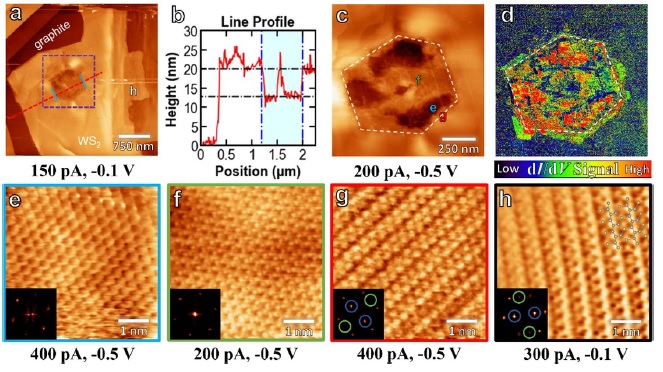
Local 2M (topological superconductor) to 2H (semiconductor) Phase Change in WS2The investigation of exotic properties in two-dimensional (2D) topological superconductors has garnered increasing attention in condensed matter physics, particularly for applications in topological qubits. Despite this interest, a reliable way of fabricating topological Josephson junctions (JJs) utilizing topological superconductors has yet to be demonstrated. Controllable structural phase transition presents a unique approach to achieving topological JJs in atomically thin 2D topological superconductors. In this work, we report the pioneering demonstration of a structural phase transition from the superconducting to the semiconducting phase in the 2D topological superconductor 2M-WS2. We reveal that the metastable 2M phase of WS2 remains stable in ambient conditions but transitions to the 2H phase when subjected to temperatures above 150 °C. We further locally induced the 2H phase within 2M-WS2 nanolayers using laser irradiation. Notably, the 2H phase region exhibits a hexagonal shape, and scanning tunneling microscopy uncovers an atomically sharp crystal structural transition between the 2H and 2M phase regions. Moreover, the 2M to 2H phase transition can be induced at the nanometer scale by a 200 kV electron beam. The electrical transport measurements further confirmed the superconductivity of the pristine 2M-WS2 and the semiconducting behavior of the laser-irradiated 2M-WS2. Our results establish a novel approach for controllable topological phase change in 2D topological superconductors, significantly impacting the development of atomically scaled planar topological JJs. Read more: S. Gautam et al., 2D Mater. 11, 015018 (2024). |
|
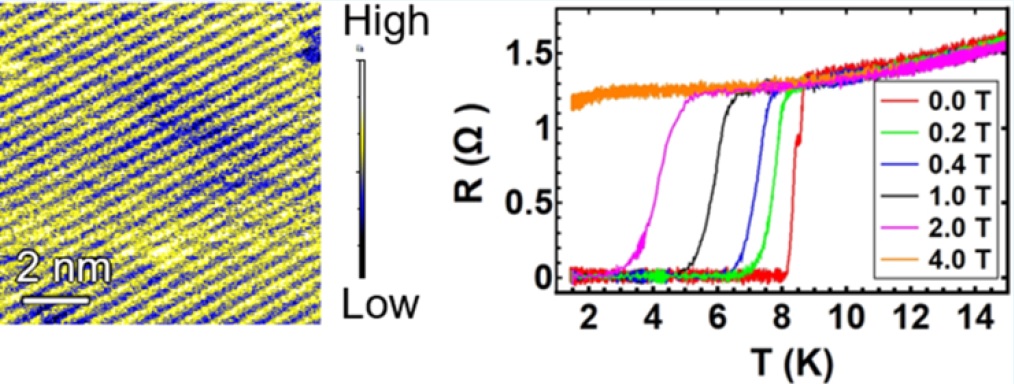
Two-Dimensional 2M-WS2 Nanolayers for SuperconductivityRecently, a newly discovered VIB group transition metal dichalcogenide (TMD) material, 2M-WS2, has attracted extensive attention due to its interesting physical properties such as topological superconductivity, nodeless superconductivity, and anisotropic Majorana bound states. However, the techniques to grow high-quality 2M-WS2 bulk crystals and the study of their physical properties at the nanometer scale are still limited. In this work, we report a new route to grow high-quality 2M-WS2 single crystals and the observation of superconductivity in its thin layers. The crystal structure of the as-grown 2M-WS2 crystals was determined by X-ray diffraction (XRD) and scanning tunneling microscopy (STM). The chemical composition of the 2M-WS2 crystals was determined by energy dispersive X-ray spectroscopy (EDS) analysis. At 77 K, we observed the spatial variation of the local tunneling conductance (dI/dV) of the 2M-WS2 thin flakes by scanning tunneling spectroscopy (STS). Our low temperature transport measurements demonstrate clear signatures of superconductivity of a 25 nm-thick 2M-WS2 flake with a critical temperature (TC) of ~8.5 K and an upper critical field of ~2.5 T at T = 1.5 K. Our work may pave new opportunities in studying the topological superconductivity at the atomic scale in simple 2D TMD materials. Read more: P. Samarawickrama et al., ACS Omega 6, 2966-2972 (2021). |
|
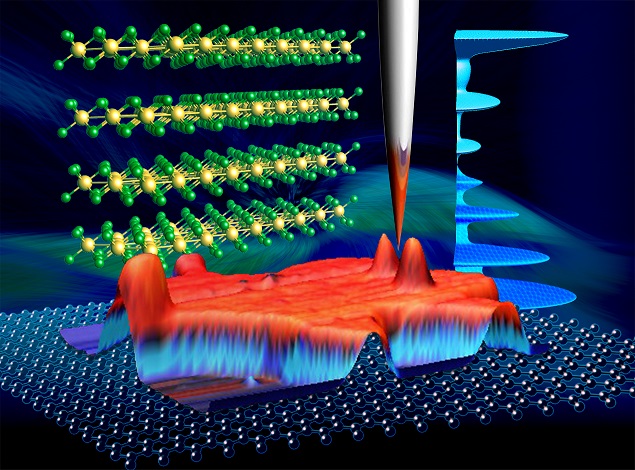
Small Energy Gap Revealed in CrBr3CrBr3 is a layered van der Waals (vdW) material with magnetic ordering down to the 2D limit. For decades, based on optical measurements, it is believed that the energy gap of CrBr3 is in the range of 1.68-2.1 eV. However, controversial results have indicated that the band gap of CrBr3 is possibly smaller than that. An unambiguous determination of the energy gap is critical to the correct interpretations of the experimental results of CrBr3. Here, we present the scanning tunneling microscopy and spectroscopy (STM/S) results of CrBr3 thin and thick flakes exfoliated onto highly ordered pyrolytic graphite (HOPG) surfaces and density functional theory (DFT) calculations to reveal the small energy gap (peak-to-peak energy gap to be 0.57 eV ± 0.04 eV; or the onset signal energy gap to be 0.29 ± 0.05 eV from dI/dV spectra). Atomic resolution topography images show the defect-free crystal structure and the dI/dV spectra exhibit multiple peak features measured at 77 K. The conduction band - valence band peak pairs in the multi-peak dI/dV spectrum agree very well with all reported optical transitions. STM topography images of mono- and bi-layer CrBr3 flakes exhibit edge degradation due to short air exposure (~15 min) during sample transfer. The unambiguously determined small energy gap settles the controversy and is the key in better understanding CrBr3 and similar materials. Read more: D. Baral et al., PhysChemChemPhys 23, 3225-3232 (2021). |
|
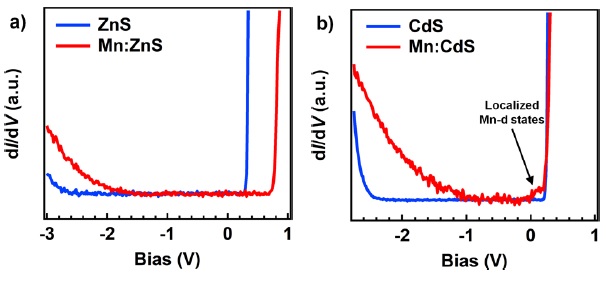
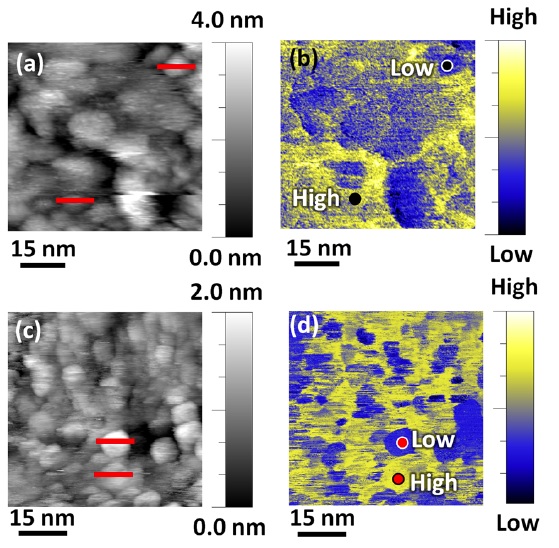
Influence of the Mn Doping on the Electronic and Magnetic Properties of CdS and ZnS Quantum DotsDoping semiconductors with transition metal elements may change the physical properties of the host materials. In a sense, the dopant can provide electron or hole doping. Also, if the transition metal has magnetic moment, it can also affect the magnetic properties. Here, we study the Mn doping in the CdS and ZnS semiconductors and revealed that the Mn doping has complex influence on the physical properties in CdS and ZnS by different mechanism. Ridig band shifting was observed in ZnS while it is not the case for CdS. Read more: A. J. Yost et al., J. Phys. Chem. C 123, 24890-24898 (2019). |
|
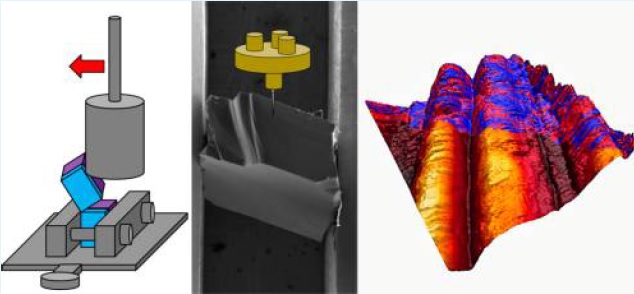
Mn dopant locations affect the sp-d hybridization strengthDilute magnetic semiconductors (DMS) have been studied for decade owing to its attractive properties of magnetism in semiconductors. Typically, DMS is achieved by doping semiconductors with transition elements, such as Mn. The sp-d hybridization between the sp band edge states of the semiconductors and the electrons in the d orbitals in the transition elements strongly influence the DMS properties. The DMS is well studied in bulk or thin film forms while the quantum dot (QD) form of DMS is considered very difficult. This is mainly due to the so-called "self-purification" process, in which the dopants tend to aggregate at the surfaces of the QDs. Despite the difficulty, many researchers have reported successful synthesis, the change of the physical properties, and the applications of the DMS QDs. However, so far, though mentioned, it is rarely studied that the location effects of the transition element dopants on the physical proeprties of host semiconducting QDs. In this study, we utilized STM/S to study PbS and Mn:PbS QDs synthesized by pulsed laser deposition methods. Combining results from various measurements and density functional theory calculation, we revealed that the Mn dopant locations may affect the sp-d hybridization strength in the PbS QDs and manifest itself as different level of bandgap widening. Read more: A. Yost et al., Appl. Phys. Lett. 111, 233101 (2017). |
|
Nano-Scale Electronic Phase Separation in Organometallic Halide Perovskite MaterialsIn recent years, organometallic halide perovskite (OHP) materials have drawn plenty of attention in photovoltaic applications. Starting in year 2009 with a moderate solar cell power conversion efficiency (PCE) of ~3 % to the outstanding ~22 % PCE in year 2016. Over the past few years, it has been reported that the OHP materials, in various combination of cations/anions, exhibit extraordinary long exiton lifetime and mean free path, echoing with the reported high PCE. It is still mysterious why this type of materials could host long-lived excitons and conduct both electrons and holes pretty well before the charge collection at electrodes. An interesting trend about this type of materials and the solar cell performance was noticed by many researchers: high PCE OHP based solar cells are typically made with mixed cations or anions. To address this trend, we recently utilized scanning tunneling microscopy and spectroscopy (STM/S) to study CH3NH3PbI3-xClx thin films in cross-sectional geometry. We revealed, of first time, the existence of two distinct nano-scale electronic phase separation. The unprecedented discovery was only possible due to the choice of the STM/S technique, which has superior spatial resolution with capability of probing electronic properties that are needed to visualize this nano-scale electronic separation. We believe this observed nano-scale electronic phase separation will have profound influences on the excitons and charges dynamics in this type of materials. Further study is planned toward this direction. Read more: A. Yost et al., ACS Appl. Mater. & Interfaces 8, 29110-29116 (2016). |