
|
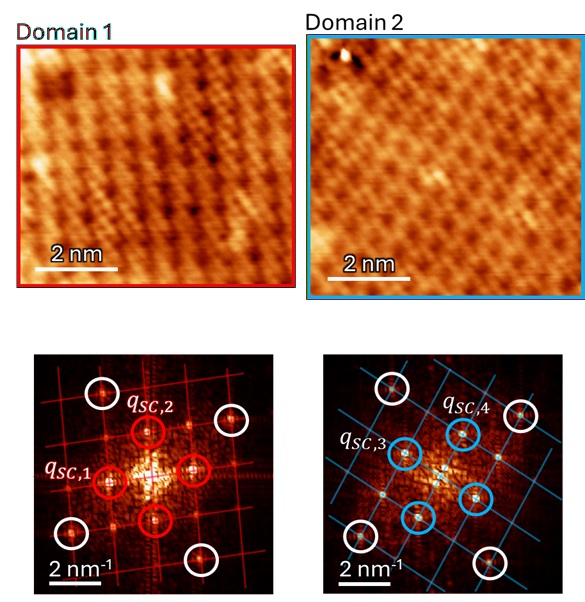
Direct visualization of the existence of surface local chemical order in a high-entropy CoCrFeMnNi alloyThe impacts of local chemical order (LCO) on the physical properties of high-entropy alloys (HEAs) have been widely discussed. However, the difficulty in unambiguously observing LCO with high precision poses a great challenge in establishing microscopic mechanisms regarding the impacts of LCO on physical properties. Furthermore, it is still unclear whether the LCO extends to HEA surfaces, which may impact surface-based properties, such as corrosion, oxidation, and catalytic activities. Through the utilization of scanning tunneling microscopy (STM), two surface LCO domains with corresponding √5 x √5 R ± 26.6 ° quasi-long-range orderings (QLRO) are directly observed on a CoCrFeMnNi surface. Density functional theory (DFT) calculations identify the LCO within QLRO supercells. The findings provide evidence of the existence of the surface LCO and demonstrate a method to directly observe the surface LCO of HEAs. With the ability to unambiguously resolve elemental configuration at atomic scale, the understanding of how LCO influences surface-based properties can be achieved, facilitating the design of HEAs with tailored functionalities. Read more: Kim et al. Nature Comm. https://doi.org/10.1038/s41467-026-71170-z. |

|
Distinguishing Elements at the Sub-Nanometer Scale on the Surface of a High Entropy AlloyMaterials in crystalline form possess translational symmetry (TS) when the unit cell is repeated in real space with long- and short-range orders. The periodic potential in the crystal regulates the electron wave function and results in unique band structures, which further define the physical properties of the materials. Amorphous materials lack TS due to the randomization of distances and arrangements between atoms, causing the electron wave function to lack a well-defined momentum. High entropy materials provide another way to break the TS by randomizing the potential strength at periodic atomic sites. The local elemental distribution has a great impact on physical properties in high entropy materials. It is critical to distinguish elements at the sub-nanometer scale to uncover the correlations between the elemental distribution and the material properties. Here, the use of synchrotron X-ray scanning tunneling microscopy (SX-STM) with sub-nm scale resolution in identifying elements on a high entropy alloy (HEA) surface is demonstrated. By examining the elementally sensitive X-ray absorption spectra with an STM tip to enhance the spatial resolution, the elemental distribution on an HEA's surface at a sub-nm scale is extracted. These results open a pathway towards quantitatively understanding high entropy materials and their material properties. Read more: L. Kim et al., Adv. Mater. 2402442 (2024). |